Close the loop on customer feedback.
Turn complaints into fixes that stick.
CLARA groups tickets, reviews and surveys into ranked problems, with the numbers and the likely cause. Each one goes to the team that owns it, and CLARA measures whether the fix worked.
- Signals
“Verification rejected my ID card with no reason given. Second attempt also failed.”
„Ich verstehe nicht, welches Dokument akzeptiert wird.“
- ProblemImpact high
Verification instructions are unclear after document rejection
184 customers · Confidence high · Owner: Onboarding Product
- DecisionApproved
Policy rules first, then four-eyes approval
- ActionDone
Jira ticket for Onboarding Product
- OutcomeLoop closed
38% fewer complaints than in the 14 days before the fix
Feedback is easy to collect. Acting on it is the hard part.
Feedback sits in different tools.
Every source in one place
Tickets, public reviews, app-store ratings and survey exports land in one stream, in German and English. Zendesk, Trustpilot, App Store, Google Play and Google reviews are built in. Other tools connect by CSV or a signed webhook.
The numbers and the reasons live in separate reports.
Themes with the numbers and the reasons
Related feedback becomes one problem, with volume, trend and severity next to the customers' own words. Each problem carries a likely cause, with the evidence for and against it.
Nobody is sure who should act.
An owner, an approver and a deadline
Each problem goes to the team that owns that part of the journey, with a due date. Proposed actions pass your policy rules and a named approver before anything reaches Jira or Slack.
Five steps from signal to measured outcome.
The dashboard follows the same five steps, so you can see where every problem stands.
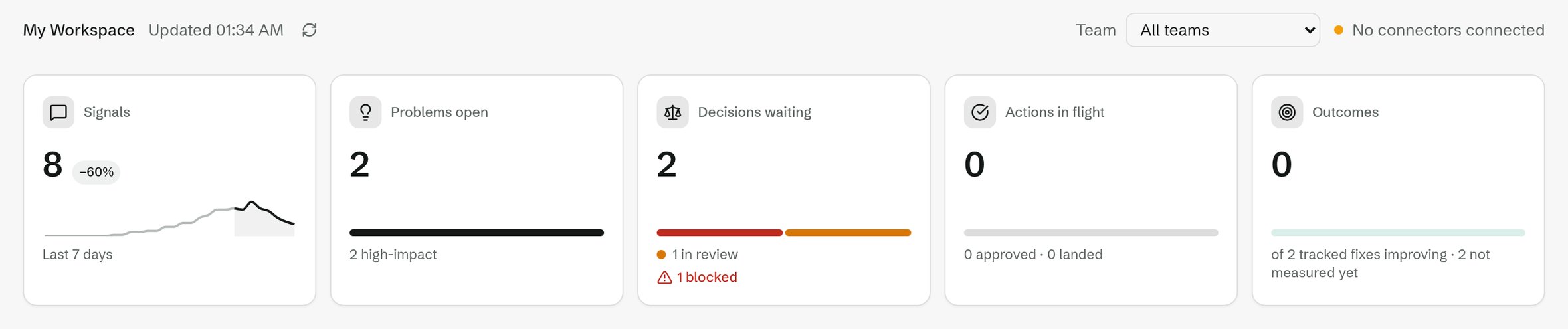
The loop at a glance, on the dashboard of the demo workspace.
Signals
Feedback from every connected source, in one format.
Problems
Related feedback grouped into problems, with evidence, likely cause and who is affected.
Decisions
Policy rules run first. Then a person approves, edits or rejects.
Actions
Approved actions go to Jira or Slack with an owner. The rest stay drafts.
Outcomes
CLARA re-counts the complaints at fixed checkpoints, and your team records what worked.
CLARA stands for Capture, Listen, Analyze, Respond, Adapt.
CLARA found what customers were really complaining about.
It started as MSc research in Responsible AI. We evaluated it on 188 public reviews from fintech, food delivery and industrial B2B, paraphrased to remove personal details.
of sentiment labels matched the customer's own star rating, across 153 rated reviews.
of genuine reviews got flagged as AI-written by a standard detector (6,740 texts tested), skewing towards angry customers. CLARA flags duplicates and bursts for a person to check instead.
of data before and after a fix, at minimum. With less, CLARA reports that it cannot tell yet.
Pervasive support unresponsiveness on critical financial issues. 14 signals, one problem.
Surfaced from a fintech's public reviews
Refunds denied for undelivered orders. 28 signals, one theme.
Surfaced from a delivery marketplace's public reviews
We name the companies in conversation, not here, so nobody reads it as an endorsement.
AI your legal team can sign off.
A person approves every consequential step, and every decision stays on record with its evidence.
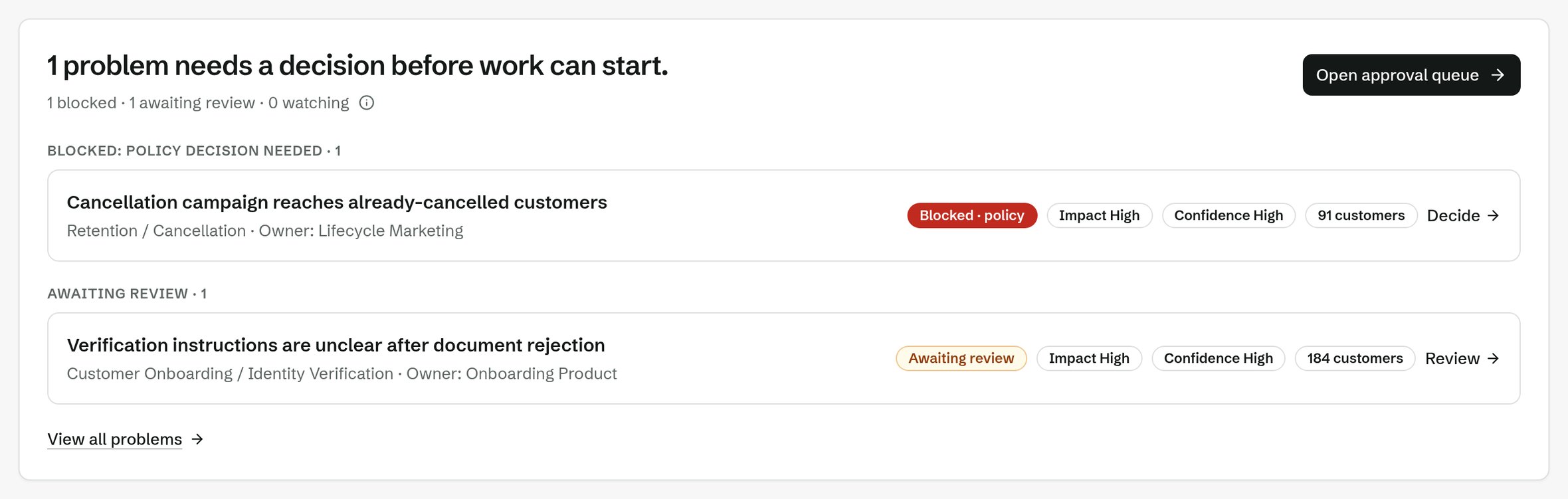
The decision queue in the demo workspace.
- EU data, EU models.
Data is stored in Germany and the EU. AI runs on EU-hosted models by default, and common identifiers such as emails and phone numbers are removed before text reaches a model.
- Approvals that hold up.
Policy rules run before any action is sent. With four-eyes on, two different people approve, and exactly the version they approved goes out.
- Separated and on record.
Row-level security keeps each company's data apart inside the database. Every decision is logged, and evidence packs carry a hash of what was approved.
- Ready for the works council.
Works-council mode shows role labels instead of names, so no per-employee metric can be derived.
Questions teams bring to CLARA.
Every answer links back to the feedback behind it.
“What are customers complaining about this week, across every channel?”
One view over tickets, reviews and app stores. Problems that start rising are flagged with the signals behind them while they are still small.
Caught early“Which problem should we fix first?”
Problems are ranked by volume, urgency, recency and the value of the affected accounts, with the verbatims attached. The loudest voice no longer decides.
Prioritised by impact“Will our DPO and works council sign off on this?”
EU-hosted models, common identifiers removed before any model call, human approval on every consequential step and a works-council mode. A DPA and a DPIA template are available on request.
Governed before it ships“Did the fix actually work?”
After release, CLARA re-counts the complaints at fixed checkpoints against the target you set. If the data is too thin to tell, it says so.
Measured after releaseReads where customers talk. Acts where your teams work.
No migration. CLARA connects to the tools you already run and sends approved work back into them.
See CLARA on your own feedback.
A 30-minute scoping call. Bring one feedback source and the question you most want answered.
or write to hello@odradekai.com
Practitioner rather than buyer? Join the research study →